
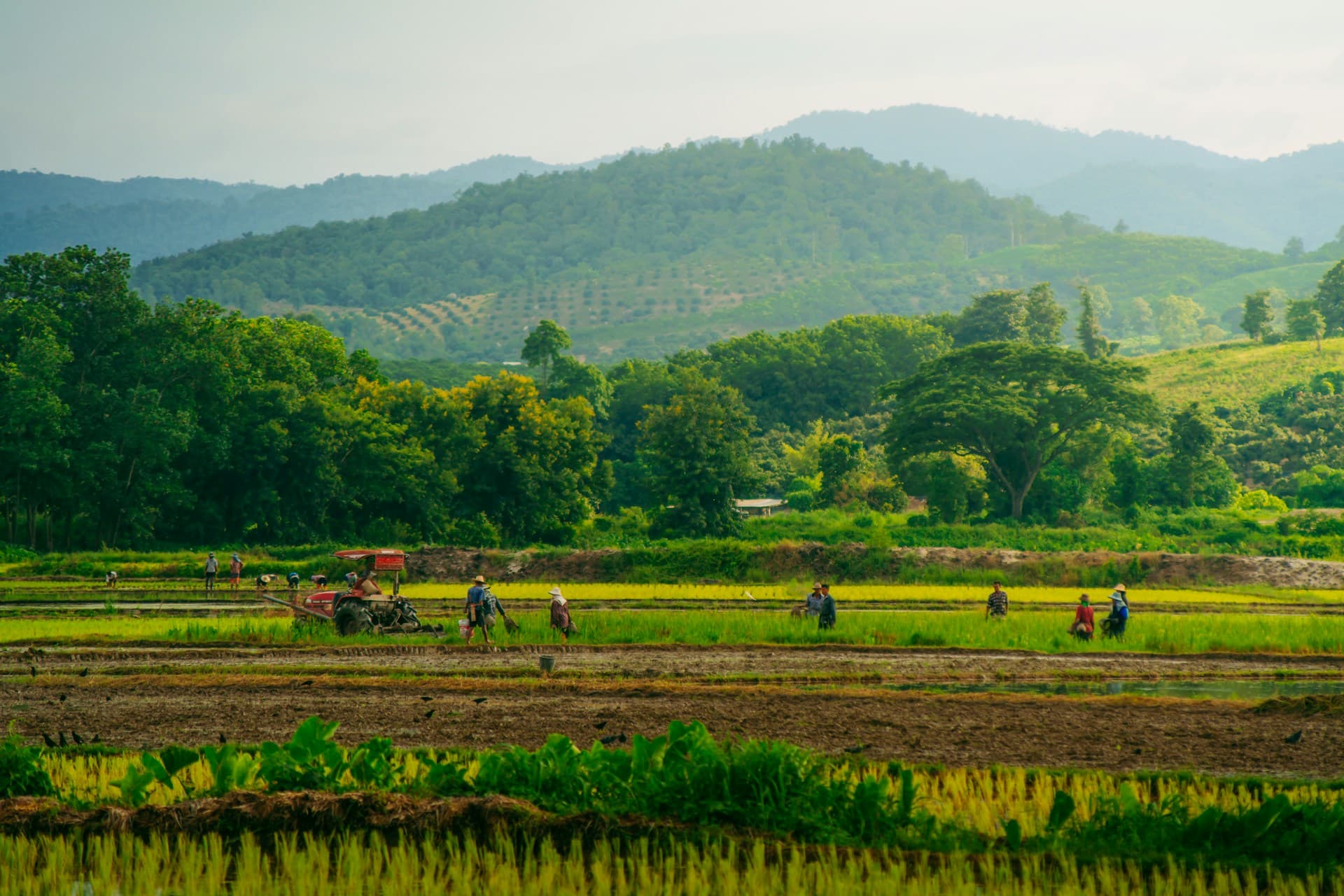
Most botanical ingredients in international trade pass through three to five intermediaries between the field and the manufacturer. Each handover is an opportunity for material to be substituted, blended, or to lose its traceability. Each is also a margin layer, which is why the model is so durable: nobody in the middle of the chain has an incentive to shorten it.
This piece argues that direct grower partnerships aren't just a sustainability story — they're the only structural way to make chain-of-custody claims credible. And it explains what documented custody actually has to demonstrate.
What "broker-sourced" looks like in practice
A typical broker-sourced supply chain runs something like this: a village-level aggregator buys from individual growers at harvest, sells in bulk to a regional consolidator, who sells to an export broker, who sells to an import broker, who sells to a manufacturer. Material is graded, repacked, and blended at multiple stages. Identity is asserted by the seller at each step and inherited by the buyer.
The problem isn't fraud — most participants are operating in good faith. The problem is information loss. By the time a 25 kg sack reaches the manufacturer, the question "which farms did this come from?" cannot be answered. The question "was this lot adulterated upstream?" can only be answered statistically, by testing.
That's fine for commodities. It is not fine for material going into a clinical-grade extract.
What direct sourcing actually requires
Direct doesn't just mean "skipping the broker." It means establishing a relationship with the grower or grower cooperative that produces the material, and maintaining that relationship across seasons. In practice this looks like:
- Named growers or named cooperatives — not "Thailand sourcing" but "the cooperative at Nakhon Si Thammarat, operating under licensed cultivation framework X."
- Pre-season cultivation agreements — what's planted, where, at what scale, against what target spec
- Origin-side quality controls — drying, grading, and primary identity verification done at origin under a documented protocol
- Closed shipment paths — material moves from origin to the manufacturing facility under sealed and tagged consignment, with no intermediate repacking
This is more expensive per kilogram. It is also the only way to answer the chain-of-custody questions a downstream buyer is going to ask.
What documented custody has to show
A real chain-of-custody record names, for every lot:
- The origin — GPS coordinates, the cooperative or grower, the cultivation block
- The harvest — date, technique (wild-collected, cultivated, sustainably harvested under quota), the operator
- The origin processing — drying parameters, grading, the first identity test, the lot ID at origin
- The consignment — shipment date, route, seal numbers, intake date and lot ID at the manufacturing facility
- The manufacturing — extraction batch ID, finished-extract lot ID, the cross-reference back to the origin lot
A buyer should be able to take a finished-extract lot number and trace it back to the field block it came from. If the supplier can't produce that trace, the chain-of-custody claim is rhetorical.
Why this matters for regulated end-uses
For nutraceutical and pharmaceutical-grade end-uses, chain-of-custody isn't an ethics claim — it's a regulatory expectation. GACP (Good Agricultural and Collection Practice) and the various GMP regimes that govern botanical drug substances all require documented traceability to the field. For botanicals that fall under CITES (the convention on international trade in endangered species), or under traditional-knowledge benefit-sharing requirements (the Nagoya Protocol), the documentation is also a legal compliance artifact.
Brokered supply chains can sometimes assemble enough paperwork to satisfy these requirements on paper. They cannot produce a continuous record. The difference matters when a regulator asks for one.
The practical answer
The honest pitch for direct sourcing is not that it's cheaper — it isn't. It is that for the specific class of end-use that requires accountability to the field, brokered supply chains can never close the loop, and direct supply chains can. Manufacturers serving that class of end-use should be paying the premium to do it properly. Buyers serving that class of end-use should be asking their suppliers, every time, "Where did this specific lot come from? Can you trace it back?"
If the answer takes more than a day, they should keep asking.