
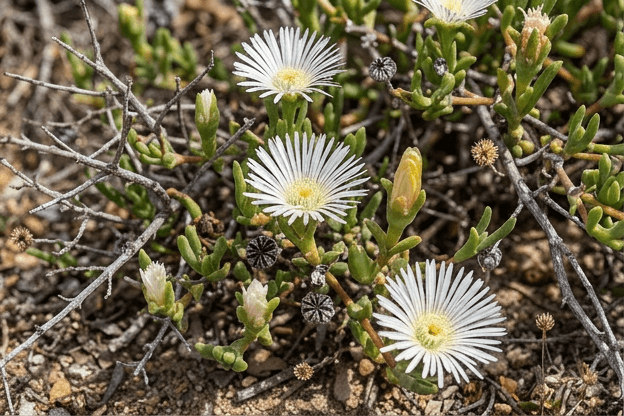
For most of the modern botanical-ingredients industry, Sceletium tortuosum — known by its South African common name kanna — was an obscurity. A succulent native to the semi-arid Karoo and Namaqualand regions, used ceremonially and socially by the Khoikhoi and San peoples for centuries, occasionally written about in ethnobotanical literature, very rarely standardised as a commercial extract.
That changed quickly. Kanna has moved from "ethnobotanical curiosity" to "active ingredient in mainstream stress, mood, and cognitive formulations" in roughly five years. The shift wasn't driven by marketing; it was driven by a wave of new pharmacological characterisation that explained why the plant has the effects users have been reporting all along.
This piece walks through the actual science — what the alkaloids do, why the recent attention is justified, and where the open questions still sit.
The alkaloid profile
Kanna's pharmacological activity is dominated by four mesembrine-type alkaloids:
- Mesembrine — historically considered the lead compound, dominant in most cultivated material
- Mesembrenone — increasingly recognised as the more pharmacologically interesting of the two
- Mesembrenol and mesembranol — present in smaller amounts, contribute to the full chemotype
The four alkaloids are conventionally measured together as "total alkaloids" by HPLC-UV against a mesembrine reference standard. Modern standardised extracts target alkaloid concentrations in the 0.5%–2.5% range depending on grade and intended use.
The ratios matter as much as the totals. Different cultivars and different fermentation protocols produce material with quite different mesembrine-to-mesembrenone ratios — and the recent pharmacology suggests those ratios materially affect the activity profile.
What the alkaloids actually do
The compounds in this paragraph have been characterised across the last fifteen years; the synthesis of what they collectively do has clarified over the last five.
Serotonin reuptake inhibition. Mesembrine and mesembrenone are both characterised SRIs. Mesembrenone in particular shows potent in-vitro inhibition of the serotonin transporter (SERT). The mechanism is similar in principle to the SSRI drug class, though the potency, selectivity, and clinical-dose context are entirely different. This is the leading explanation for the mood and stress-tolerance effects users consistently report.
PDE4 inhibition. This is the more recent finding. Mesembrenone and several other constituents are inhibitors of phosphodiesterase-4 (PDE4), a regulator of cyclic AMP signalling. PDE4 inhibition is the mechanism of a class of pharmaceutical drugs used for inflammatory and CNS conditions (apremilast, roflumilast). At the concentrations achievable from a botanical extract, the relevant PDE4 effects are cognitive and anti-neuroinflammatory rather than dramatic — but they help explain why kanna's cognitive profile feels different from a pure SSRI mechanism would predict.
VMAT-2 modulation. Less well-established, but signalled in several in-vitro studies: kanna's alkaloids appear to interact with the vesicular monoamine transporter, potentially influencing the synaptic availability of dopamine and noradrenaline alongside serotonin. This is the proposed explanation for the engagement / mild euphoric quality reported with the traditional preparation, distinct from the calming SRI effect.
The dual SRI + PDE4 mechanism is what makes kanna pharmacologically novel within the nutraceutical category. Most botanical mood ingredients work through one mechanism at relevant doses. Kanna's clinical-dose effects appear to involve two genuinely distinct pathways operating simultaneously.
What the clinical literature actually shows
The clinical evidence base is small but growing, and meaningfully better than it was even three years ago.
Acute stress response. Multiple controlled trials of standardised kanna extract (Zembrin, the most studied commercial standardisation, typically dosed at 25 mg/day) show measurable reductions in subjective anxiety and stress-response biomarkers. The effect sizes are modest but consistent. The acute (single-dose) effects appear meaningfully faster-onset than typical SSRI pharmacology would predict, which fits the dual-mechanism profile.
Cognitive performance. Several trials show improvements in executive-function task performance — particularly tasks involving cognitive flexibility and processing speed — after standardised kanna dosing. The cognitive effects are not dramatic; they are within the range you'd expect from a moderate cholinergic or PDE4-acting compound rather than a stimulant.
fMRI-level findings. The most striking work is the brain-imaging studies showing reduced amygdala reactivity to fear-relevant stimuli after kanna dosing. This is consistent with the SRI mechanism but is a more direct neurobiological signal than self-reported mood measures.
The studies are small, but they are real RCTs with active controls. Several are funded by industry, which is worth noting, but the methodology in the best-known studies (Terburg, Stein, et al. on Zembrin) is independent academic work using standard psychiatric trial designs.
Why the industry attention now
Three things converged.
Mechanism clarity. The dual SRI + PDE4 pharmacology was clarified across the late 2010s and the 2020s. Before that work, kanna's effects were described as if by analogy — "similar to" an SSRI, "similar to" a nootropic. Now there's a coherent mechanistic story that explains why the effects are what they are, which gives formulators confidence to build around it.
Standardisation maturity. Reliable standardised extracts only became widely commercially available in the last decade. The earliest extracts in the export channel had highly variable alkaloid content. Standardised Zembrin (≥ 0.35% mesembrenone-dominant, validated HPLC) became a reference point that other suppliers had to match.
Regulatory positioning. Kanna sits in a comparatively clean regulatory position in major markets — listed as a dietary supplement ingredient in the US (with a Self-Affirmed GRAS notification on the most studied standardisation), and accepted as a novel food in several jurisdictions. Compared to botanicals that come with regulatory complexity, kanna is unusually clean.
What still isn't well understood
Three gaps worth being honest about:
Chronic-use pharmacology. Most of the controlled trial work has been short-duration. The pharmacology of regular SRI exposure — habituation, tolerance, withdrawal patterns — is well-characterised for synthetic SSRIs but not yet adequately characterised for kanna. The traditional Khoikhoi/San use patterns suggest the plant tolerates regular use well, but the formal evidence base for that claim is mostly observational and historical.
Drug-interaction profile. Because the dominant mechanism is serotonin reuptake inhibition, kanna theoretically interacts with prescription SSRIs, MAOIs, and other serotonergic drugs in the same way clinically prescribed SRIs interact. The clinical interaction literature is sparse. Standard supplement-labelling guidance is to avoid combining with other serotonergic compounds, and we think that's the right default.
Cultivar and fermentation variability. The pharmacology described above is mostly characterised against modern cultivated material, often fermented post-harvest using protocols developed in the last 20 years. Wild-harvest and traditionally-prepared material has a different chemotype distribution, and the pharmacological work hasn't been comprehensively repeated against the traditional preparation. It's plausible that the modern standardised product and the traditional preparation differ in clinically-meaningful ways.
What to look for on a CoA
Commercial-grade material destined for nutraceutical formulation should carry, at minimum:
- Total mesembrine-type alkaloids as percentage, by validated HPLC method
- Individual concentrations of mesembrine, mesembrenone, mesembrenol, mesembranol — so the chemotype can be independently inspected
- Mesembrenone-to-mesembrine ratio — the chemotype shorthand for whether the material is the higher-pharmacological-activity profile
- Identity confirmation — TLC, HPTLC, or DNA barcoding against Sceletium tortuosum reference
- Standard contaminant screening — heavy metals, pesticide residues, microbial limits, aflatoxins
A CoA reporting only "total alkaloids" without the individual breakdown leaves the question of activity profile unanswered.
Bottom line
Kanna's commercial moment is being driven by genuine pharmacological clarification rather than by category marketing. The mechanism is interesting, the clinical evidence is modest but real, and the regulatory positioning is favourable. The categories still need maturity — particularly around chronic-use safety, drug interactions, and the cultivar / fermentation question — but the directional answer is that the attention is justified. The next two years of clinical work will determine whether the early enthusiasm survives the larger trials that the category needs.