
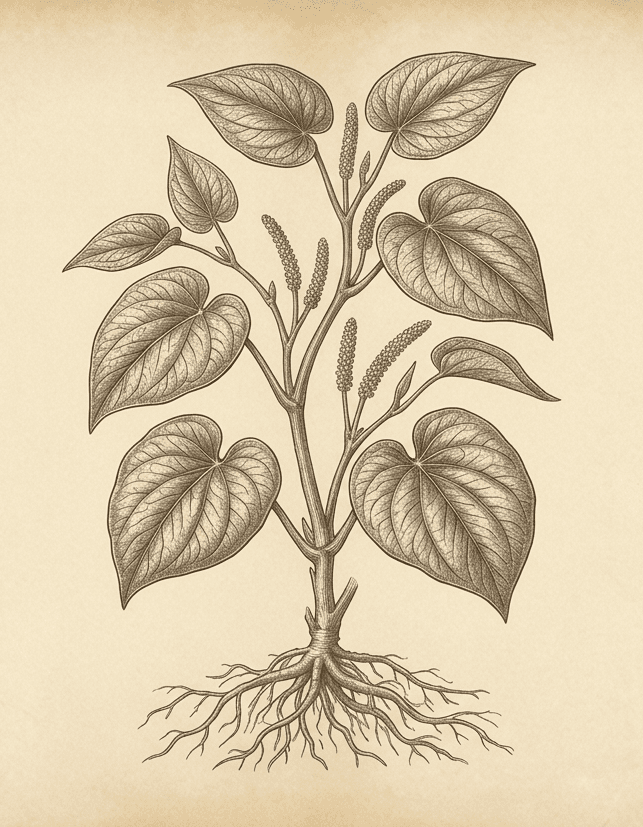
Kava (Piper methysticum) is one of the few botanical ingredients where the cultivar choice — not just the species — determines whether the material is acceptable in international trade. A kava lot that tests against the same total-kavalactone target as another can be commercially viable in one and unacceptable in the other, on the basis of its chemotype: the relative ratios of the six major kavalactones.
This piece explains what the chemotype encodes, why "noble" cultivars are the only ones allowed under several major export frameworks, and what we look for at intake.
The six major kavalactones
Kava's pharmacological activity is dominated by six lactones, conventionally numbered in order of chromatographic appearance:
- Demethoxyyangonin (DMY)
- Dihydrokavain (DHK)
- Yangonin (Y)
- Kavain (K)
- Dihydromethysticin (DHM)
- Methysticin (M)
A kava extract is typically standardised to total kavalactones (sum of the six, by HPLC-UV at 240 nm). But the chemotype — the relative percentages of each lactone — is what distinguishes one cultivar from another, and what determines acceptability.
How chemotype is reported
The chemotype is conventionally written as a six-digit string where each digit represents the rank of the corresponding lactone, from highest concentration (1) to lowest (6). A chemotype of 246531 means:
- Kavain (4) is the most abundant lactone
- Dihydrokavain (2) is second
- Methysticin (6) is third
- Dihydromethysticin (5) is fourth
- Yangonin (3) is fifth
- Demethoxyyangonin (1) is sixth
This is a coarse coding — it doesn't capture the absolute ratios — but it is the established shorthand and is sufficient to distinguish a noble cultivar from a non-noble one at a glance.
What "noble" means
A noble kava cultivar is one whose chemotype starts with either kavain (4) or dihydrokavain (2) as the dominant lactone. The traditional Pacific noble cultivars (Borogu, Melomelo, Palasa, Borogoru, the Fijian Loa and Lawena groups) all fall into this chemotype space.
The opposite category — non-noble, sometimes called "two-day kava" — has chemotypes dominated by dihydromethysticin (5) and methysticin (6). Material with this profile is associated in the ethnobotanical record with delayed adverse effects, including the protracted hangover-like symptoms that gave the name. It is also where most of the historical hepatotoxicity signal in European kava products has been attributed.
The export regulations follow the ethnobotany. Vanuatu's 2002 Kava Act explicitly prohibits the export of non-noble cultivars and tudei (non-noble) chemotypes. Fiji applies similar restrictions. Material destined for European, US, and Japanese nutraceutical channels is, in practice, restricted to noble chemotypes regardless of source country.
Why total-kavalactone alone is insufficient
A material can hit a 30% total-kavalactone target with a noble chemotype or with a non-noble one. The single-number assay does not distinguish them. A standardisation programme that reports only total kavalactones — without the chemotype profile — is leaving the question of cultivar acceptability unanswered.
A credible kava CoA reports:
- Total kavalactones (percentage, by validated HPLC-UV method)
- The chemotype as the six-digit code
- The percentage of each individual lactone (so the chemotype can be independently verified)
- The noble/non-noble determination based on the chemotype
If any of those four are missing, the CoA cannot support the cultivar claim.
What we do at intake
Material entering our facility from Pacific grower partners is identity-checked at three points. At origin, the cooperative confirms cultivar by visual identification against established reference morphology — leaf shape, stem pigmentation, internodal spacing — and by farmer-provenance records. At intake, we run HPLC against a reference standard and compute the chemotype. If the dominant lactone is not kavain or dihydrokavain, the lot is quarantined pending resolution.
A second cross-check runs at finished-extract release. Extraction can shift the chemotype slightly (the lactones have different solubilities in ethanol and water), so the finished-extract chemotype is not necessarily identical to the starting material. We document both, and the CoA carries the finished-extract chemotype, with the source-material chemotype available on request.
The shorter answer
For any buyer evaluating kava material for an international market: ask for the chemotype, in the six-digit form, on the CoA. If the supplier responds with only a total-kavalactone number, they are either skipping a quality control or hoping you will. Either way, the conversation is not finished.