
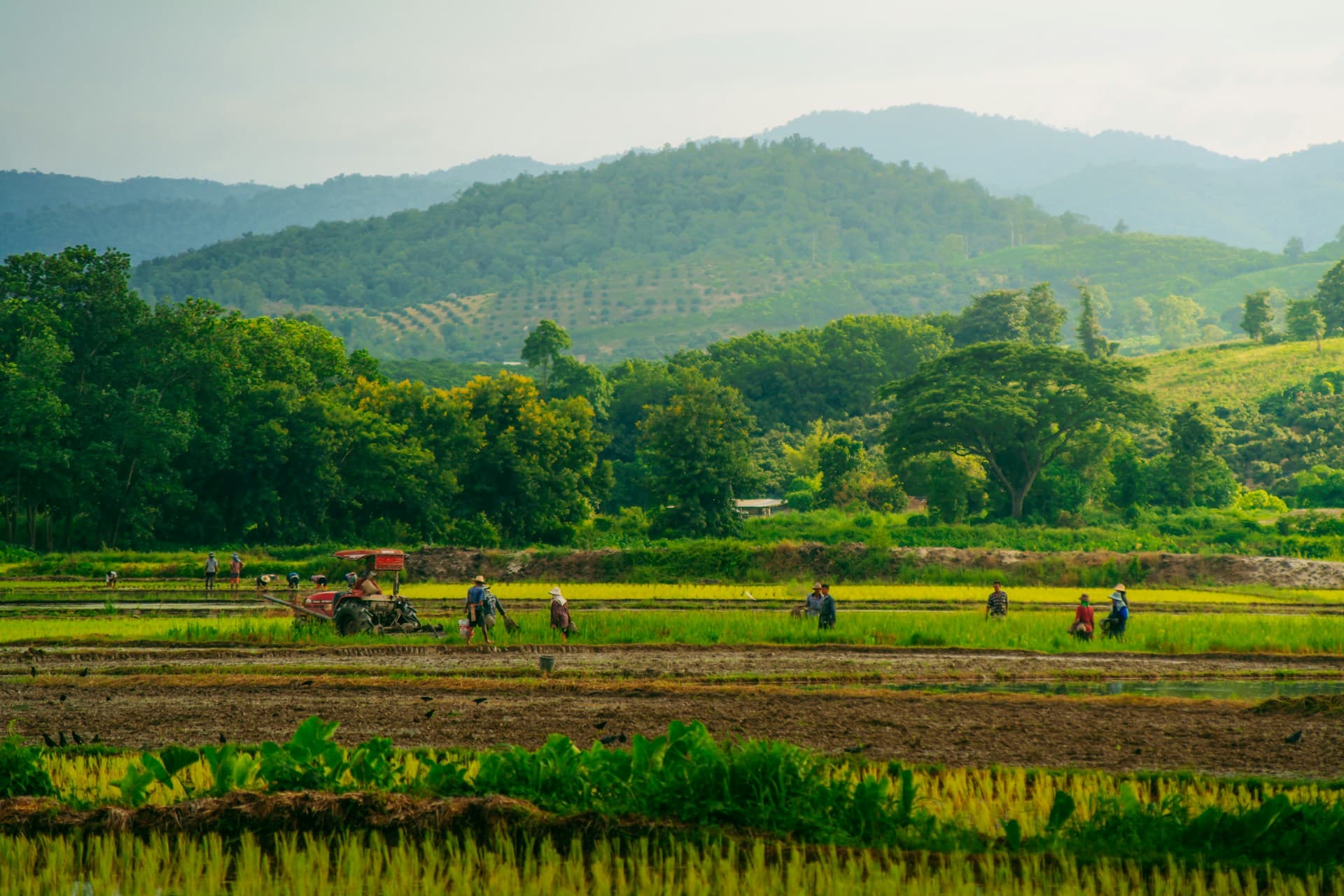
Most of the kratom in the global supply chain passes through the hands of farmers whose families have worked with the plant for generations — long before there was an export market, long before there was a Western consumer. This is a profile of the farm network behind our Thai kratom supply: a 34-province partnership spanning the southern peninsula, the central plains, the north-eastern provinces, and the northern hills.
The point isn't to romanticise. Agricultural work in Southeast Asia is hard, and the global kratom market has reshaped the realities in ways that aren't uniformly good. The point is to make visible the supply chain that produces a category most buyers procure without ever thinking about who picks it.
Four regions, 34 provinces
Thailand's standard administrative geography splits the country into four regions: South, Central, North-East, and North. Our partner network covers all four, but the weighting reflects where the plant has historically grown best and where the multi-generational farming tradition is most established.
The South — eight partner provinces. Our deepest network. Chumphon, Surat Thani, Nakhon Si Thammarat, Phatthalung, Songkhla, Trang, Krabi, and Ranong. These are the heartland kratom-growing provinces — year-round canopy, lowland tropical climate, and farming families who've worked with the plant for three generations or more. Nakhon Si Thammarat in particular anchors the southern programme, with established cooperative structures that pre-date the export era.
The Central plains — 18 partner provinces. The widest provincial reach, but with a different cultivation logic. Flat-land cultivation operating under more formalised licensing frameworks, anchored on the Kamphaeng Phet farmer engagement programme (350+ growers in that single programme alone) and the Bangkok-region grower base feeding domestic processing. Provinces include Kamphaeng Phet, Nakhon Sawan, Phetchaburi, Ratchaburi, and the cluster around Ayutthaya and Saraburi.
The North-East (Isan) — four partner provinces. A smaller but strategically important footprint. Nakhon Ratchasima, Khon Kaen, Nong Khai, and Nongbualamphu. Partner growers in Isan operate under the licensed cultivation framework introduced after the 2021 law change, and the regional programmes have focused on integrating kratom alongside existing cash crops rather than replacing them.
The North — four partner provinces. Chiang Mai, Phrae, Nan, and Phayao. Hill-region partnerships built through the northern farmer roadshow programme. Smaller volumes than the South but the partnerships are durable, and the regional climate produces materially different leaf chemistry that some markets specifically request.
The Southern tradition
To understand the network you have to understand the South, where the cultural relationship with the plant is oldest. Surat Thani, Nakhon Si Thammarat, and Songkhla sit on the southern peninsula between the Gulf of Thailand and the Andaman Sea. The provinces are known for rubber, palm oil, and rambutan — and, in pockets, for kratom. The trees grow well in the lowland tropical climate; established groves produce harvestable leaves multiple times a year.
Kratom has been part of agricultural and working life in this region for as long as anyone can remember. Older farmers describe their grandparents chewing fresh leaves during the working day — the way coffee or betel nut were used in adjacent traditions. The plant was simply present, the way certain trees are present in any place where they grow easily.
Our primary southern partner cooperative has been working with kratom for three generations. The current head of the operation took over from his father in the early 2000s. The trees range from young plantings to mature specimens that pre-date the family's formal cultivation — some of the larger ones may be a century old.
How harvest actually works
Harvest happens in cycles tied to the trees' maturation rhythm rather than the calendar. Workers — mostly local, often family members or long-time employees — pick selected leaves by hand, sort them by maturity, and bring them in for processing. Leaves destined for different vein-colour products are picked at different maturation stages; the selection happens at the tree, not at the mill.
Once picked, leaves are washed and brought into shaded indoor drying rooms. Drying in shade rather than direct sun preserves the active alkaloids in the leaf — it's slower and more labour-intensive, but the difference shows up in the finished product. The southern farms have chosen the longer process consistently across generations.
After drying, leaves are visually inspected and sorted. Stems and damaged material are removed. The remaining leaf is milled to a consistent fine powder. Each batch is sampled, sealed, and labelled with batch identifiers that travel with the material through to our facility intake and through extraction.
What the 2021 law change actually meant
For most of the modern export era, kratom was technically illegal in Thailand — despite being culturally embedded for centuries. The legal status was reversed in 2021, allowing legal cultivation and trade under a licensing framework administered through the Department of Thai Traditional and Alternative Medicine.
The change had three practical effects on the supply network:
It legitimised what was already happening. The Southern farming tradition didn't pause for a decade; it just operated under legal ambiguity. The 2021 reforms put a regulatory framework around a cultivation reality that already existed, which meant cooperatives could formalise quality and consistency programmes that had been managed informally.
It opened the Central provinces. Formal licensing meant farmers in regions without the deep cultural tradition — particularly Central Thailand — could enter the category as a structured economic crop. This is why the Central regional footprint is now the widest by province count. The Kamphaeng Phet programme is the clearest example: 350+ growers, 1,800 tonnes exported in a single programme year, with the licensing framework providing the legal certainty for that kind of structured scaling.
It changed who the regulator is. Pre-2021, the relevant regulatory thread was narcotics control. Post-2021, it's traditional medicine and economic-crop policy. The shift matters because the policy levers are different — the conversation now is about Geographical Indication protection, export-market strategy, and grower-fairness frameworks rather than enforcement.
Why this matters for material going into extracts
A multi-generational southern farm and a recently-licensed Central plains cooperative both produce kratom that hits the same headline marker concentration. But they don't produce equivalent material. Mature-tree leaf from a generationally-managed grove has a different alkaloid profile than freshly-cultivated leaf from a structured economic-crop programme. Neither is "better" in the abstract — they serve different downstream products.
This is the reason a manufacturer working with the category needs network depth rather than a single sourcing relationship. The 34-province network isn't a marketing footprint; it's how we match material chemistry to extraction tier. The southern peninsula feeds the higher-spec extract production. The Central programmes feed steady commercial supply. The North and Isan provinces fill specific regional-chemistry requests.
What the network gives us
Continuous supplier relationships are what allow a manufacturer to ask for specific harvest practices, dryroom protocols, and pre-shipment QC — and to know reliably what each partner produces. Spot-market buyers cannot ask for any of that.
The 34 provinces aren't a credential. They're how a botanical-ingredient manufacturer maintains optionality across cultivar, season, and product tier without losing chain-of-custody. Behind every province on the map is a relationship and a documented record. That's the part of the supply chain a CoA can't show, and it's the part that determines whether the next batch will be like the last one.