
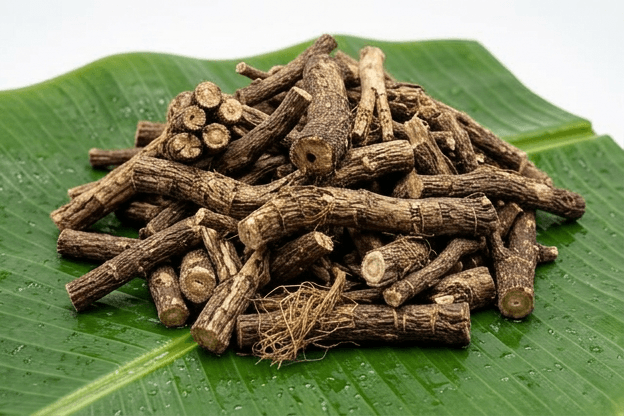
Eurycoma longifolia — known across the trade as tongkat ali, longjack, or pasak bumi depending on the region — has become one of the most commercially active botanicals in the adaptogen category over the last decade. It is also one of the most adulterated. A trade-floor sample taken from a randomly-selected supplier has materially worse odds of being authentic, full-spec tongkat ali than the equivalent kava or kanna sample.
This piece walks through what actually distinguishes pharmaceutical-grade tongkat ali from commodity-grade or fraudulent material: the root maturity question, the eurycomanone standardisation problem, and the three adulteration patterns that show up most often.
The root maturity rule
The first thing to understand about tongkat ali is that it is a root product, and the root takes time to develop the relevant phytochemistry. Cultivated Eurycoma longifolia trees produce minimal eurycomanone — the dominant marker quassinoid — in their early years. Concentration builds slowly across the tree's growing life. The standard reference point in the trade is that material from trees younger than four or five years is considered commercially marginal.
A widely-cited heuristic is the "five-year root" — the suggestion that pharmaceutical-grade tongkat ali should come from trees at least five years old. The number is approximate; the real driver is eurycomanone development, and trees grown under different climate, soil, and shade conditions hit comparable concentrations at different ages. But the directional rule holds: younger trees produce thinner material, regardless of what the standardisation programme claims to extract.
This is where the supply-chain economics get interesting. A five-year root represents five years of standing investment with no harvest. The commercial pressure to harvest earlier is strong, and not always resisted. Material from three-year roots will pass a single-marker eurycomanone assay if it's standardised aggressively, but the broader quassinoid and saponin profile is wrong — the activity-relevant phytochemistry hasn't matured.
Eurycomanone — what it is, what it isn't
Eurycomanone is a quassinoid — a class of bitter-tasting plant terpenoids found in the Simaroubaceae family. Across the Eurycoma longifolia literature it is treated as the lead marker for tongkat ali activity, and most commercial standardisation programmes target a specific eurycomanone percentage (typical ranges: 0.8%–2.0% for commodity grade, 2.5%–5%+ for premium standardisations).
A few things worth understanding about eurycomanone as a marker:
It is one of several active compounds, not the only one. The activity-relevant fraction of a tongkat ali extract is the broader quassinoid panel (eurycomanone, eurycomanol, eurycomalactone, and several minor congeners) plus the high-molecular-weight peptide and polysaccharide fraction. Standardising to eurycomanone alone is a partial-information measurement.
It is the easiest constituent to spike. Eurycomanone is isolatable and synthesisable. A material that doesn't naturally hit a standardisation target can be "topped up" with isolated eurycomanone. The single-marker HPLC assay passes; the broader quassinoid profile is wrong. This is the most common adulteration pattern in the category.
Its absolute concentration is sensitive to extraction method. Water-based extraction (the traditional preparation) and ethanol or DMSO-based extraction yield different eurycomanone-to-total-quassinoid ratios. A "5% eurycomanone" claim from an ethanol extract isn't directly comparable to a "5% eurycomanone" claim from a water-based extract.
Credible standardisation reports eurycomanone alongside the broader quassinoid panel, ideally with the extraction method named and the soluble polysaccharide content separately specified.
Three adulteration patterns we see
The category has three recurring adulteration patterns. They aren't always fraud in the legal sense; sometimes they're loose quality programmes that look like fraud from the buyer's perspective.
Marker spiking with isolated eurycomanone. Described above. The single-marker assay passes; the broader phytochemistry is wrong. Caught by fingerprint chromatography (full quassinoid panel HPLC) or by mass-balance analysis comparing total quassinoids to single-marker assay.
Species substitution. Eurycoma longifolia is sometimes substituted or blended with Eurycoma apiculata (a related but distinct species) or with cheaper non-Eurycoma root material. Eurycoma apiculata has a similar morphology and a partially-overlapping phytochemistry; visual identity verification at intake can miss it. DNA barcoding catches it; HPLC fingerprinting with reference material catches it.
Powder dilution with neutral root flour. Bulk powdered tongkat ali is occasionally diluted with neutral cassava or yam root flour at the milling stage. Eurycomanone assay still reports a percentage of the (now-diluted) material. Caught by mass-spectroscopy of total quassinoid content, or by simple total-quassinoid-to-eurycomanone ratio analysis (the ratio shifts in a characteristic way when the substrate is diluted).
For a manufacturer downstream of these adulteration risks, single-marker testing at intake isn't sufficient. The category requires fingerprint-level identity and quantification work, ideally at intake and again at finished-extract release.
Why direct sourcing matters disproportionately for this category
The adulteration patterns described above all happen in the middle of the supply chain. The grower harvests the root; somewhere downstream — at the village aggregator, the regional consolidator, the export broker, the import broker, the powder-milling facility — material is substituted, blended, or spiked. By the time a 25 kg sack reaches the manufacturer, the trail is cold.
This is why tongkat ali is the category where direct grower partnerships matter most. A direct relationship with a named cooperative gives the manufacturer:
- Visibility on tree maturity — the cooperative knows how old the trees are, because they planted them. Spot-market buyers don't.
- Identity-controlled material flow — material moves from origin to facility under sealed and tagged consignment, no intermediate repacking, no opportunity for substitution.
- Pre-harvest cultivation alignment — the manufacturer can specify root-age minimums, harvest windows, and primary post-harvest handling at the cooperative level, rather than catching problems at intake.
Our Southeast Asia tongkat ali sourcing operates on this model. Material moves directly from the partner growers in Indonesia and Malaysia through documented chain-of-custody to our facility, where it is fingerprint-tested at intake against eurycomanone, the full quassinoid panel, and species identity. Material that doesn't pass any of those three checks is quarantined.
What to look for on a CoA
The minimum useful tongkat ali CoA names:
- Eurycomanone percentage, with the validated HPLC method documented
- Total quassinoids as a separate quantification — flags the marker-spiking failure mode
- Soluble polysaccharide content — flags the powder-dilution failure mode
- Species identity — TLC, HPTLC, or DNA barcoding against Eurycoma longifolia reference, distinct from E. apiculata
- Extraction method named — so the eurycomanone percentage is comparable across suppliers
- Standard contaminant screening — heavy metals, pesticide residues, microbial limits
A CoA missing the total-quassinoid number and the species identity check is incomplete for this category specifically. Those are the two checks that catch the dominant adulteration patterns. Without them, the supplier is asking the buyer to trust the chain.
The shorter version
Tongkat ali is in an unusual position commercially. The clinical and traditional-use evidence is reasonable; the adulteration economics are pervasive; the supply chain has not yet matured to the point where commodity buyers can routinely trust the trade-floor product. Pharmaceutical-grade material exists, but it costs meaningfully more than the bulk market suggests it should, because producing it correctly requires patient cultivation and disciplined chain-of-custody. A buyer paying commodity prices and assuming pharmaceutical-grade material is, statistically, getting something other than what they think.
Ask for the broader quassinoid panel. Ask for the species check. Ask where the trees are and how old they were at harvest. If the supplier can answer all three, you're talking to someone who can do the work. If they can't, you're talking to someone hoping you won't ask.